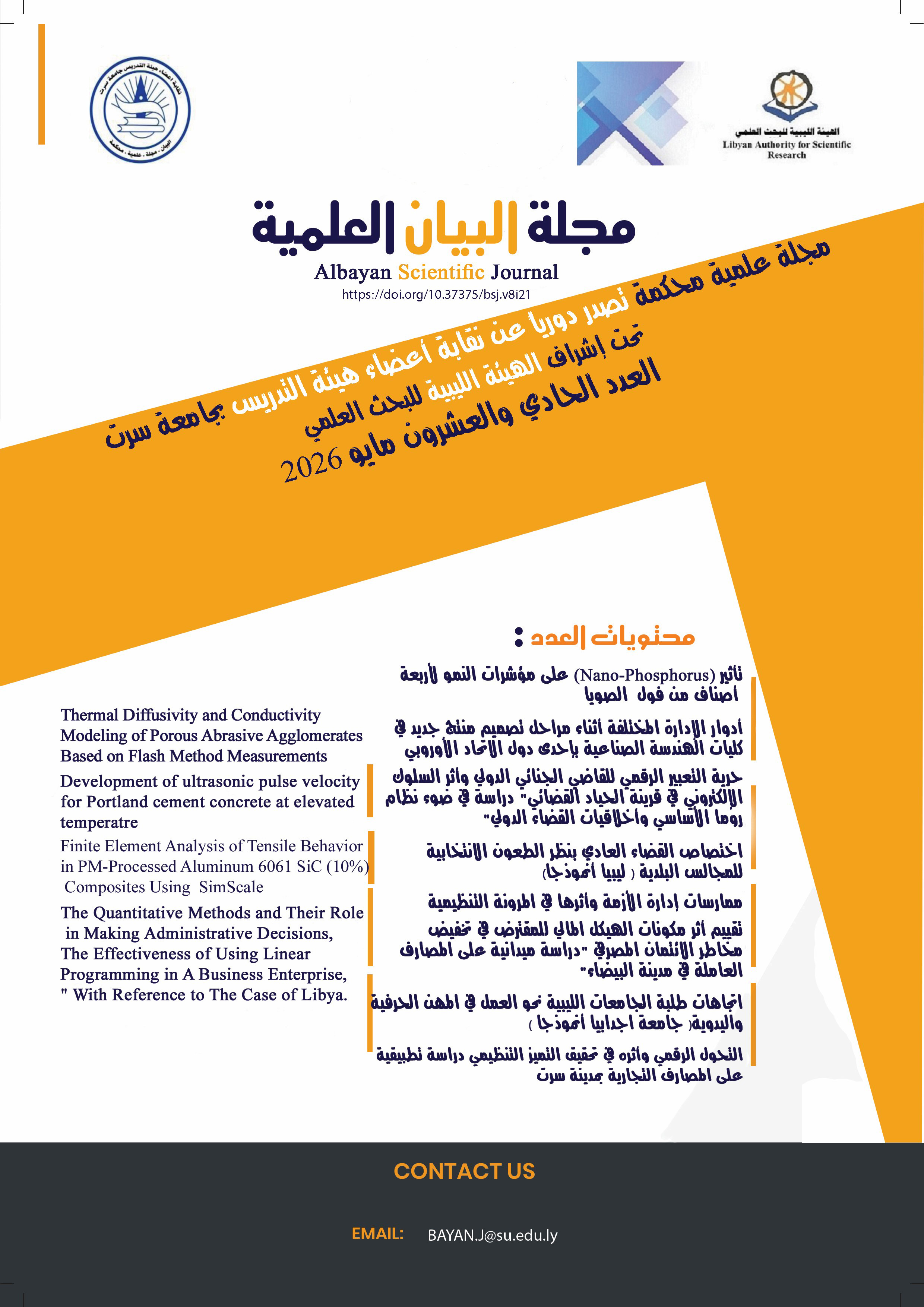
Crisis management practices and their relationship to organizational resilience
DOI:
https://doi.org/10.37375/bsj.v8i21.4050Keywords:
Crisis Management, Organizational Resilience, Preparedness and Learning, Structural Resilience, Competitive EnvironmentAbstract
This study aimed to investigate the impact of crisis management practices, in their dimensions (preparedness, learning, and leadership), on enhancing organizational resilience at the National Commercial Bank - Misrata Branch, in light of the challenges and fluctuations facing financial institutions. The study adopted the descriptive-analytical approach as its scientific framework. Primary data were collected using a questionnaire distributed to a stratified random sample of the bank's employees. A total of (72) valid questionnaires were retrieved for statistical analysis and processed using the Statistical Package for the Social Sciences (SPSS) to test hypotheses and analyze the impact relationships between variables.
The study concluded that there is a statistically significant positive impact of crisis management practices on achieving organizational resilience. The results showed that the bank enjoys a good level of effective leadership and the ability to learn from crises, while revealing a need to develop preparedness aspects and contingency plans. Furthermore, the results indicated that the levels of structural and technological resilience were moderate, necessitating practical recommendations focused on the importance of enhancing investment in technical infrastructure, developing proactive mechanisms for crisis management, and empowering human resources to ensure rapid response to environmental changes and enhance organizational sustainability.
References
البلوشي، ن. (2022). دور المرونة التنظيمية في تطوير الخدمات الإلكترونية المقدمة من قبل المنظمات الحكومية. مجلة الإدارة العامة، 62(1)، 23-41.
الحربي، خ. (2021). علاقة المرونة التنظيمية على الأداء التنظيمي: دراسة تطبيقية على منظمات القطاع الخاص في السعودية. مجلة إدارة الأعمال العربية، 41(2)، 57-78.
الحريري، رافدة. (2020). إدارة الأزمات في المؤسسات التربوية. دار المناهج للنشر والتوزيع.
الدباس، ر. (2021). دور المرونة التنظيمية في تعزيز الميزة التنافسية للشركات. مجلة أبحاث اقتصادية وإدارية، 17(2)، 45-62.
الرفاعي، م. (2019). تأثير المرونة التنظيمية على الأداء المؤسسي في القطاع الحكومي. المجلة العربية للعلوم الإدارية، 26(1)، 117-134.
الزعبي، أ. (2020). علاقة المرونة التنظيمية على الأداء التنظيمي في منظمات الأعمال الأردنية. مجلة جامعة النجاح للأبحاث (العلوم الإنسانية)، 34(5)، 819-840.
الشريف، أحمد محمد. (2019). إدارة الأزمات في المؤسسات التربوية. دار الفكر العربي.
الشيخ، محمد علي. (2020). دور إدارة الأزمات في تحقيق الميزة التنافسية للمنظمات. مجلة الإدارة والاقتصاد، 12(3)، 45-62.
العامري، صالح مهدي محسن، والغالبي، طاهر محسن منصور. (2016). إدارة الأعمال: منظور منهجي متكامل. دار وائل للنشر.
العنزي، س. (2022). دور المرونة التنظيمية في تعزيز القدرات الابتكارية للمنظمات. مجلة الإدارة والاقتصاد، 28(3)، 87-104.
الفهداوي، محمد سليم. (2018). إدارة الأزمات والكوارث. دار الراية للنشر والتوزيع.
Baškarada, S., & Koronios, A. (2018). The 5S organizational agility framework: a dynamic capabilities perspective. International Journal of Organizational Analysis, 26(2), 331-342.
Burnard, K., & Bhamra, R. (2011). Organizational resilience: development of a conceptual framework for organizational responses. International Journal of Production Research, 49(18), 5581-5599.
Crandall, W. R., Parnell, J. A., & Spillan, J. E. (2013). Crisis management: Leading in the new strategy landscape. SAGE Publications.
Easterby-Smith, M., & Lyles, M. A. (Eds.). (2011). Handbook of organizational learning and knowledge management (2nd ed.). Wiley.
Gunasekaran, A., Rai, B. K., & Griffin, M. (2011). Resilience and competitiveness of small and medium size enterprises: an empirical research. International Journal of Production Research, 49(18), 5489-5509.
Huang, P. Y., & Li, Y. H. (2017). The Influence of Organizational Flexibility on New Product Development Performance: The Moderating Role of Environmental Uncertainty. Journal of Management & Organization, 23(4), 548-566.
Lengnick-Hall, C. A., & Beck, T. E. (2005). Adaptive fit versus robust transformation: How organizations respond to environmental change. Journal of Management, 31(5), 738-757.
Lengnick-Hall, C. A., Beck, T. E., & Lengnick-Hall, M. L. (2011). Developing a Capacity for Organizational Resilience Through Strategic Human Resource Management. Human Resource Management Review, 21(3), 243-255.
Mallak, L. A. (1998). Putting organizational resilience to work. Industrial Management, 40(6), 8-13.
Namasivayam, S. (2021). Organizational flexibility and its impact on organizational performance. International Journal of Productivity and Performance Management, 70(3), 559-578.
Richard, O. C., Barnett, T., Dwyer, S., & Chadwick, K. (2004). Cultural Diversity in Management, Firm Performance, and the Moderating Role of Entrepreneurial Orientation Dimensions. Academy of Management Journal, 47(2), 255-266.
Richard, P. J., Devinney, T. M., Yip, G. S., & Johnson, G. (2009). Measuring organizational performance: Towards methodological best practice. Journal of Management, 35(3), 718-804.
Sheffi, Y., & Rice Jr, J. B. (2005). A supply chain view of the resilient enterprise. MIT Sloan management review, 47(1), 41.
Sherehiy, B., & Karwowski, W. (2014). The relationship between work organization and workforce agility in small manufacturing enterprises. International Journal of Industrial Ergonomics, 44(3), 466-473.
Starr, R., Newfrock, J., & Delurey, M. (2003). Enterprise resilience: managing risk in the networked economy. Strategy and Business, 30, 70-79.
Van Oosterhout, M., Waarts, E., & van Hillegersberg, J. (2006). Change factors requiring agility and implications for IT. European Journal of Information Systems, 15(2), 132-145.
Zheng, T., Xing, Y., & Cao, J. (2021). Organizational flexibility, strategic adjustment and sustainable competitive advantage: the moderating role of environmental uncertainty. Sustainability, 13(10), 5373.